Category Archives: Economics

The electric vehicle transition is reshaping procurement pay in the West Midlands

Buyers and procurement officers in the West Midlands were the lowest paid in the country for their profession in 2024. By 2025, they were second only to London. The shift reflects something structural happening to the region’s labour market.


Few job titles sound less exciting than “buyer and procurement officer.” But the pay data for this occupation in 2025 tells an unexpectedly sharp story about what the transition to electric vehicles is doing to the West Midlands workforce.

Median annual pay for procurement professionals in the West Midlands rose from £32,292 to £40,824 between 2024 and 2025, an increase of 26%. Most other regions saw increases of 1-9% or stayed flat. Scotland and the North West barely moved.

Article content

A region built on supply chains

The West Midlands accounts for around 32% of UK automotive employment and is home to JLR, Stellantis, and a dense network of tier-1 and tier-2 suppliers. For decades that concentration made the region a natural home for procurement professionals who understood how automotive supply chains worked.

The shift to electric vehicles is changing the skills that concentration demands. New supply chains for battery materials, power electronics, and new categories of component require procurement professionals who can manage entirely different supplier relationships, often with overseas partners, and across materials with volatile pricing. That kind of specialist capability is in short supply nationally — and disproportionately in demand in the West Midlands.

Public investment is amplifying that demand. A £12.5m Supply Chain Transition Programme launched in 2025 specifically targets diversification into EV, battery, aerospace, and medtech supply chains. A £15m manufacturing transformation fund is also active. Regional manufacturing output is already more than 10% above 2019 levels, with 9,000 jobs added since 2023.

From lowest to near the top

In 2024, a procurement professional in the West Midlands earned roughly £4,000 less per year than one in London and around £5,000 less than one in the East Midlands. By 2025, the West Midlands had overtaken the East Midlands entirely and was within £800 of London’s median.

That kind of catch-up from a low base does not happen through routine salary reviews. It requires genuine demand pressure: employers competing for a limited pool of people with the right skills, in a region where those skills are suddenly more valuable than they used to be.

Reed’s 2025 procurement salary guide specifically identifies the West Midlands as one of theregions where procurement and supply chain salaries have increased the most, attributing it to the strong performance of transport and logistics firms — which in this region means, in practice, the automotive transition.

Why other regions stayed flat

London and the South East were already high-cost environments for procurement talent, so additional demand produces smaller percentage moves. Yorkshire, Scotland, and the North West have less manufacturing concentration and fewer large-scale EV transition anchors in their supplier base. There is no equivalent structural driver pushing procurement pay sharply upward in those regions right now.


Why radiographer pay surged in the West Midlands and fell in London

The same occupation, the same national pay scale, but very different regional stories. New data from Wage Wizard reveals what’s really happening to radiographer pay across the UK.

NHS radiographers work to a national pay scale. Agenda for Change rates are set centrally, apply uniformly across England, and moved by 5.5% in 2024-25. So why does the latest ONS earnings data show median annual pay for radiographers rising by 25% in the West Midlands while falling by 11% in London?

The answer tells you more about how the NHS is managing a workforce crisis than about pay rises but it is a genuinely important story about what is happening to radiography services across the country.

The West Midlands: a diagnostic centre building boom

The West Midlands has seen one of the most intensive expansions of Community Diagnostic Centres anywhere in England. Birmingham’s first CDC opened in 2024 at Washwood Heath; a North Solihull centre followed in spring 2025; a South Birmingham centre was announced for summer 2025. The West Midlands Imaging Network now spans 15 NHS trusts serving 6.7 million patients, and Midlands CDCs have collectively delivered nearly 1.5 million diagnostic tests since mid-2024.

Building that capacity quickly, in a profession with a 13% national vacancy rate, means competing hard for experienced staff. CDCs disproportionately recruit Band 6 and Band 7 radiographers: the senior practitioners who can work more independently and handle the volume these facilities are designed to deliver. In 2024, the West Midlands ASHE sample for this occupation was weighted toward entry-level and mid-grade workers. By 2025, a significant cohort of more senior, higher-paid staff had joined the regional workforce.

The result: median annual pay moving from £34,788 to £43,629 not because anyone received a 25% pay rise, but because the composition of who is working in the region shifted sharply upward in seniority.

That is a meaningful distinction. But it is also a real signal: the West Midlands is now a materially different labour market for experienced radiographers than it was twelve months ago.

London: the agency crackdown bites

London’s story runs in the opposite direction and has a different structural cause.

In 2024, London’s median radiographer pay of £53,944 sat well above the Agenda for Change Band 7 maximum of around £48,000. That premium reflects the high proportion of agency and bank staff captured in the London ASHE sample radiographers working at rates that can reach two to three times standard NHS pay. London NHS trusts, under persistent staffing pressure, had been among the heaviest users of temporary radiology staff.

In late 2024, that changed. The Health Secretary mandated a system-wide freeze on agency spending; NHS England cut total agency spend by nearly £1 billion in 2024-25, a reduction of around 30%. Radiology where the NHS had been spending an estimated £325 million per year on temporary staff, up 24% year-on-year was a prime target.

By April 2025, when ASHE data is collected, the high-pay agency cohort that had inflated London’s median was significantly smaller. The median fell to £47,855, much closer to the standard AfC Band 6-7 range, not because any radiographer took a pay cut, but because fewer high-cost temporary workers were captured in the data.

What the data actually shows

The chart below shows median annual pay for medical radiographers by region in 2024 and 2025, for the eight regions with sufficient data quality to report reliably.

Article content

The broad picture is one of convergence: the two lowest-paid regions in 2024 (West Midlands, £34,788; East Midlands, £36,413) have moved significantly toward the national centre of gravity. The outlier at the top (London, £53,944) has come down. Most other regions remained broadly stable.

What this means for radiographers and patients

For radiographers, the regional picture has become more equal but also more complex. The West Midlands is clearly hiring, and hiring at senior grades: it is potentially a good moment to be an experienced practitioner in that market. London’s apparent pay premium has narrowed considerably, though this reflects a reduction in lucrative agency work rather than a change in permanent salaries.

For patients, the CDC expansion in the West Midlands represents a genuine step-change in imaging capacity. The question is whether the workforce to sustain it is there: with a 13% national vacancy rate and an agency crackdown limiting the flexibility that trusts have relied on, the pressure on permanent radiography staff is not going away.

Explore pay for radiographers and hundreds of other occupations across every UK region at Wage Wizard

A firm view on resources

https://www.economist.com/finance-and-economics/2023/04/04/why-economics-does-not-understand-business

When I was first poking my nose into economics as a teenager I came across the famous definition that it is the study of allocating finite resources. Since then I’ve worked in government, at a regulator and for multiple companies, and I can stand very firmly behind the opinion that academic economics has a very poor understanding of how resources are allocated within a commercial organisation, and how decisions are made.

However, there is a field that has been developing quietly over the past twenty or so years that seeks to understand firms as a collection of resources and how these resources can be optimally combined to improve firm performance.

My first encounter with it was while studying the relationship between investment in ICT and productivity. A number of studies looked at complementary business changes/characteristics alongside the introduction of things like email, e.g. email had more of an impact on organisations that had a flatter structure. Lowering the costs to communication makes more of an impact when you can be more effective by communicating with more people.

Now everyone wants to be data driven, but being more data driven is so much more complex than dashboards and data literacy classes. I am looking at how organisations can improve their decision-making by not only investing in fancy tech and data infrastructure, but changing how they make decisions and investing in organisational learning. It is not a simple story, and every organisation has different challenges, but there are common themes that can be used to help drive improvement.

Maybe there will be studies we can publish in the future, and someone can revisit this Economist article.

The dangers of old people

Last week I wrote about how it’s ok for governments to spend more than their tax take when the economy is depressed.  This week I’m going to show that while additional spending can be helpful to kick-starting the economy, there are good things to spend the money on, and there are less good things.

The current government made a big fuss in 2010 about how it was going to protect the incomes of pensioners by guaranteeing to increase the Basic State Pension by the highest of inflation (the Retail Prices Index), average earnings, or 2.5%.  This might seem like a nice policy, something to make us all feel warm and fuzzy about making sure that pensions can take care of themselves.

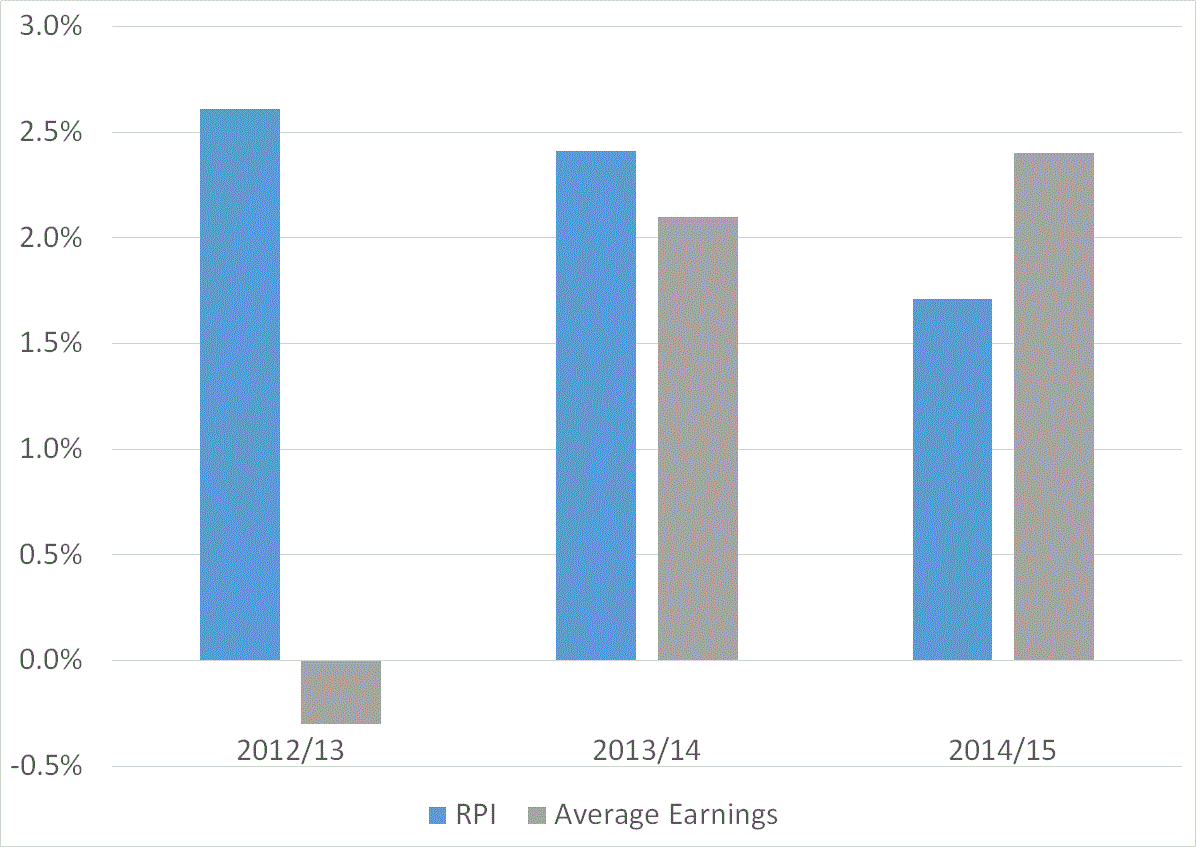
However, this policy has been incredibly expensive.  In 2012/13 RPI inflation was 2.6% and average earnings fell by 0.3%, so all the oldsters got an additional 2.6%.  The total spend on the Basic State Pension in 2011/12 was £74.2bn.  Therefore increasing the pension rate by 2.6% increased the spend on State Pension by £1.9bn.  The value of the increase above average earnings (2.6% – -0.3%) was worth around a quarter of a billion pounds.

blog_graph_pensions

Since then each year pensions have got another 2.5%.  Boom – another cool two billion to spend on cruises and Werthers Originals. Average earnings have picked up but continue to grow at less than 2.5%.

The problem with this is that there are many, many more things that government could spend money on which would do more good for the country than shovelling cash into the pockets of old people.  For example, the UK Apprenticeships programme has been successfully providing young people with skills that employers explicitly want.  It has been evaluated as adding £18 to the economy for every pound of government money spend on it.  That is a return of 1800%.  Not bad Vince. Not bad.

You might be asking what is the return on spending on pensions.  Zilch.  A pound spent on pensions is merely moving money from one pocket to another.

In 2013/14 the total spend on all Enterprise and Skills programmes in the UK was £4bn.  The increase in spending on State Pension was half of the total spend on Enterprise and Skills.

If just a quarter of that increase were used for Apprenticeships that would mean the economy would not be only £250m better off, it would be £4.5bn better off.

Crappy spending decisions like the Triple Lock is why governments that listen disproportionately to old people are not good economic stewards.

Young people: Vote!

Older people, if you want your children and grandchildren to live in a wealthy society, don’t listen to the siren calls of bigger cash transfers. (and tell your children and grandchildren to vote).

Governments shouldn’t worry about red ink.

In this age of blogs, Twitter and newsfeeds the default position for most people is to ingest content that they find agreeable and which is presented in digestible chunks.  When 140 characters is the go-to format for most opinions, a 500 word piece for a blog or a newspaper is rarely on the menu.  Many of the arguments against the coalition government’s policy of fiscal consolidation have therefore attempted to conform to the preferred format of the content browsers who flit from one opinion tree to another.

This has meant that many opinions end up sounding shrill (Laurie Penny and Owen Jones, I’m looking at you) or failing to convey the subtlety that is important to so many economic issues.

An article by Oxford economist Simon Wren-Lewis in the latest issue of the London Review of books illustrates starkly why this is dangerous. (yes, it’s more than 500 words)

Public endorsement of the policy of fiscal consolidation (or austerity) has been fed by the presentation of the economy as being like a household or a business that has to balance its books to survive.  This simple analogy has been used by the Chancellor to demonstrate the Conservatives’ frugality and competence at economic management – everyone else has to try and stay in the black, so government should too.

This view has been mostly swallowed whole by the media and regurgitated to the public with little criticism. Media economic correspondents and commentators have tended to focus on the views of City economists who, as Wren-Lewis points out are generally either trying to be sensationalist or advance the interests of their investor clients.

The fact that the coalition government continues to poll well on economic management is based on the public having a completely wrong view of how a national economy actually works.  Regardless of whether you think the country would be better off with a smaller state, we should all be appropriately informed about the pros and cons are of the various ways of achieving it.

“Balancing the books” of government when the country is in a recession is a very bad idea. A very, very bad idea.

If a business or household is constantly spending more than it earns then its stock of debt will increase. For a business, increasing debt to make an investment can increase revenue, but using debt to finance your operations isn’t going to end well if there isn’t some external factor that is going to improve your margins.  Using debt to finance an investment is still risky as well because it may not pay you back – people might not buy the product, the oil well might be no good, the big machine may not be reliable.

When you’re running a national economy many of the constraints a business faces are absent.  For example, a government’s revenue comes from taxes.  Taxes increase with economic activity, either from income tax, corporate profits or consumption (via VAT).  Therefore, if a government can increase economic activity then they may be able to achieve a prolonged increase in tax revenue as people continue to spend money and add value with services and products.  Reducing current taxes is one way to do this – VAT was reduced in 2009 as a way to stimulated purchases.  Increasing spending is another way to stimulate economic activity.  Investment is a particularly good way to stimulate activity because an asset is created which generally delivers some improvement to the country’s infrastructure (better broadband connections, better roads etc, better school buildings) and also results in the people working on the infrastructure having more money in their pockets to spend on goods and services. The first effect is a bit risky; like the big machine, it may not work as intended.  However, if you pay a company to build a road then the workers and owners are definitely going to be better off.

The only thing that ever prevents this from being maximally effective is if people save the money they have.  In some countries this could be an issue: Japan and Germany.  However, one thing the UK population is particularly good at is spending money!

There are various ways to pay for these types of policies, but that is a separate issue.  The analogy of balancing the books with respect to budget deficits is completely bogus – the media should stop being so ignorant about the issue, academia should help them do this, and we the public should beware of politicians who present such simplistic arguments.

In 1925 Winston Churchill followed a similar policy to Osbourne’s in order to maintain the gold standard.  The British economy was crippled by debts to the USA after WW1 and Churchill’s attempts to ‘balance the books’ brought the country to its knees.  Things only really started improving with re-armament after 1935.  This was such an appalling misjudgement that John Maynard Keynes wrote a 32-page essay called The Economic Consequences of Mr. Churchill on why Churchill was an idiot.

If only Keynes were alive today (if only…), he would have written The Economic Consequences of Mr. Osbourne, and he would have been able to summarise it in 140 characters.

Gold vs Bitcoin

A wet Sunday afternoon has let to the exploration of my Netflix ‘to watch’ list, which is normally compiled by clicking through ‘more like this’ for about 20 minutes before I go to bed.  Today this led me to alight on End of the Road: How Money Became Worthless.

It’s been a while since I dug around the dark conspiracy-filled underbelly of the internet so I was not immediately looking for signs of film that had been produced by a team that all have a room in their basement lined with guns and cans of beans.

However, after a while all the pieces start to come together and by the end I was half expecting someone to accuse all the world’s ills of being caused by Jews and the Illuminati.  Although it is littered with comments which can quite easily be rebutted by appeal to logic, solid evidence or at the very least well-established conventional economics, there are some things said which I think worth responding to, in particular in the context of the current debate going on about Bitcoin and whether it is a currency that should be taken seriously.

The gist of the film is that currency backed by gold is the natural order of things and that the “experiment” that the world has been part of since the abandonment of the gold standard in 1971 is going to come crashing down, due to all the horrendous fiscal crimes which fiat money allows governments to commit.  Put slightly less alarmistly: a currency which is backed by gold means that the amount of money in circulation is determined by the value of gold, and this is something which is relatively stable over time – gold has always been valuable and trusted as a store of wealth.  Therefore governments were not able to print money unilaterally without very obviously risking credibility .

However, when the US ceased allowing dollars to be converted to gold in 1971, the countries involved in the first Bretton Woods system of international financial exchange moved to a fiat currency system where their own currencies were backed by reserves of dollars, rather than gold.  The film alleges that the value of the dollar in this system is held up by a giant ponzi scheme comprised of the US government, the international banking system and “the media”. This ponzi scheme results in enormous national debt which is used to fuel the economy, and then is financed by printing money.

There are umpteen other tinfoil hat arguments made, but the response to the question “is it preferable to have a currency backed by gold” highlights some issues about bitcoin.

What is a currency for? The purpose of a currency is to facilitate exchange, i.e. for me to transfer value to a you in exchange for something you are giving me.  A good currency is one where you can then take what I have given you and use it to buy something from someone else.  (This is why currency is generally superior to bartering – relying on someone simultaneously offering what I want and wishing to accept what I will give for it is very, very difficult). It’s also helpful if the currency is easy to move around and can be subdivided into small enough units to pay for sundry items.  The bottom line is that currency is a measure of value and key for success is that it is trusted by all parties.

How can a currency be improved by having a fixed exchange rate with gold? If you are suspicious of a currency: you don’t trust other people not to tinker with it, including the government, then you might want to have assurance that the money you are given for selling a product can be converted into something that you do trust, like gold.  If you live in a world where your government is debasing the coinage, then demanding convertibility to gold is a rational response! However, this sort of activity ultimately leads to instability and a government that wants to stay in power (as opposed to a divine monarch) has an incentive to maintain a stable currency.

So a backing with gold is one way of making a currency trusted, but clearly not the only way.  Furthermore, the value of gold is only derived from the fact that its supply is constrained and that humans like shiny things, and have liked them for a long time.  Other natural substances that are in similarly short supply (semi-precious gems, amber, meteorites) do not hold the same mystical value as gold.  It has been  demonstrated that people are happy to use anything as currency as long as other people will accept it and the value it represents doesn’t change unpredictably.

Which brings me on to bitcoin. To date there has been some debate over whether bitcoin will ever be recognised as medium of exchange with the same level of acceptance as any national fiat currency.  The strength of feeling on both sides of the argument has led some to stake a pair of alpaca socks on the outcome.

Bitcoin is gradually moving towards two of the criteria for being an effective currency:

  • after you have dedicated a gigabyte of your home computer’s hard drive to the background data, you are away (it’s mostly portable)
  • the current bitcoin system allows it to be subdivided into one ten-millionth, i.e. 0.00000001 bitcoins. At the time of writing this means that the smallest unit a single bitcoin can be divided into is equal to about 0.5c (1btc = 494usd)

Therefore the only quality that bitcoin lacks is general acceptance and trust.  The dramatic changes in its dollar value over the last two years, partly fueled by speculation, have not helped this.  The graph below illustrates the extent of this continued variation. (apologies for some of the sins of this graph – I’m still getting my head around Excel  2013 and was too lazy to boot up Stata).

bitcoin value

N.B. it should say week-on-week change


Therefore, I would probably side with the pessimistic side of the bet.


I can’t get no … devolution!

The West Lothian question has survived since 1977 without a satisfactory answer.  Gradual devolution to the citizens of Scotland has been piecemeal and only focused on the dispensing of public funds; the Scottish Executive has authority over education, healthcare and justice policy, but almost no responsibility for raising revenue to fund them.  This has clearly led to an unsatisfactory situation where Scottish politicians spend most of their time talking about how money should be spent and how more funds can be extracted from Westminster, rather than the trade-offs and compromises which are what public policy decisions are actually about.

In their manifesto for Scottish independence, the Scottish National Party make all sorts of dodgy assertions about how Scotland is fabulously wealthy and independence will make it even more wealthy.  The economic arguments are quite convincingly demolished by the Institute for Fiscal Studies.  Even if you’re not won over by high quality fiscal analysis (a small minority, surely?) then you should be persuaded against Scottish independence by the presence of Alistair Darling – possibly the most sensible senior politician alive in the UK.

This is all very well-worn stuff.  However, a point which I hadn’t considered is the one made by the playwright, David Grieg, in the Guardian – independence in Scotland could lead to greater political and fiscal independence for cities and regions in England.

This is a very good point.

As a resident of England, I don’t really care if the Scots decide to break away from the rest of the UK as it probably won’t affect me personally very much, aside from having fewer decisions taken in Parliament by Scottish Labour MPs.  I do however care very much about diluting the power of Westminster by increasing the degree of federalism in the UK.  After living in London for six years I’ve noticed the extent to which residents of London benefit disproportionately from the economic largesse of the capital, and this is aside from the unearned windfall they get from house price rises.

The inability of the rest of the UK to manage many of its own affairs means that public money is spent on ridiculous vanity projects like the Millenium Dome, the Olympics, Crossrail and HS2.  It also means that many public institutions, both political and cultural, choose to locate in London for reasons of convenience and access to London’s labour market.

All of this is self perpetuating – people like me choose to live in London because we can earn more.  We then stay here because a) there’s quite a lot of cool stuff to do, b) even once you’ve got experience, in many industries it is difficult to find employment outside of London that maintains your standard of living and c) all our friends are here because they are in the same situation!  Employers and institutions are on the same conveyor belt.

The growth of the rest of the country is not something that is going to happen on its own.  It may not look like much of big deal now, but in twenty year’s time, the movement of much of the BBC’s activities to Manchester will have had a big impact, hopefully moving some of the media wealth of west London to Salford.  It is this type of big decision that will push influence and wealth out from the south east, and organisations are going to be more confident about making those decisions if there are powerful local governments to look after their interests.

And this is why we need to wind down Westminster.  Until the rest of England gets more devolution, and crucially, responsibility for raising revenue, resources and attention will continue to be poured in to London and the south east.  While the Scots are being asked if they want independence, the regions and cities of England should be given it.  When you haven’t had power for a thousand years it’s going to take a while to get used to the idea.

The Case for Land Value Tax

I am currently going through the rigmarole of buying a house.  The searching process has made me reflect on the distortions in the UK property market and how this is actually symptomatic of a deeper issue with the tax system.  We have been looking for houses in east London and have been struggling to find anywhere that we can afford and is also large enough for us and the early stages of a future family.  The issue is not the ongoing cost of the mortgage payments but the costs of the deposit and stamp duty which the Help to Buy scheme are supposed to help with.
This problem is caused by high and ever-rising house prices.  Why are houses so expensive in the UK? The main issue in London is constrained supply.  While there are an increasing number of new houses and flats being built, from my personal experience they are generally aimed at the top of the market.  They are also very small: in 2011 RIBA reported that new homes in the UK are the smallest in Europe.  Planning limitations also mean that it is difficult to build new tall buildings.  When they are allowed they are usually “luxury”.  There is also a strange cultural attachment to low-rise living.  The British seem to want to live in a village even if they are in the middle of a city.
There are also significant transaction costs to buying and selling a house.  For the seller there are the costs of estate agents and for the buyer there is the cost of stamp duty and their mortgage deposit if it is their first property.
All these factors pile in together to result in a system where not enough houses are being built, not enough houses are sold and land is not being used in the way that is best for society.
For the UK, and mainly in the south east and London, people can’t afford to live near where they work and add value.  The distortionary effect of taxing income above all other things is that it disincentivises desirable activity (work).  The lack of tax on property incentivises under-use of it: hence large mansions in central London which are un-occupied for most of the year.  People outside of the south east are penalised: someone earning £30,000 and living in Newcastle is contributing just as much to the economy as someone living in London earning the same.  However the person living in London, living in a more expensive house is occupying more of the country’s land resources.  They receive an unearned benefit from the rise in the value of their house just because of its location, not because they are adding more value to the country.
One could argue this could be resolved by levying capital gains tax on the sale of all property, rather than exempting the main residence.  However this would make the problem worse because it would increase the transaction costs of moving.  The solution is something which is a levy on the thing which is the source of the unearned income – the occupation of land.
The basic structure of a land value tax is that the owner of a parcel of land pays a regular fee based on the market value of the land.  There are clearly some issues with how the land would be valued – how would it be kept up to date if the land hadn’t been sold? – but there are many reasonable options, such as creating ward-level indices so that even if land has not been sold recently, its value is scaled up from its last sale according to more recent sales of land and buildings.
There are some issues with a land tax – it would strongly incentivise the high wealth/low income population to move to smaller/less valuable property.  While this effect is economically desirable because it frees up prime locations for those who are working to live near their work, it also has some deleterious social effects.  In most cases the freehold-owning retired would have to move out of inner city properties because their incomes would not be high enough to pay the land tax.  This could clearly have very negative effects both personally on those forced to move as they are removed from their social and support networks, but potentially also on the communities they leave behind. It could also result in the countryside being largely populated by the retired.
These negative impacts could be mitigated with a staggered introduction of the levy, or scaling it differently for those over state pension age.  While it is clearly in the public interest to have the most efficient use of land, there is a certain amount of injustice in forcing those who are currently retired to immediately compensate the younger generations for the distorted economy we have been blessed with.
The Land Tax has been discussed elsewhere (Financial Times, LandValueTax.org, LabourList). However, in the current pro-oldie climate no politician will touch it with a barge pole.  The only way to out more high-profile supporters (such as the semi-closeted Vince Cable) is to get more young people talking about it. It is being presented in some quarters as another “tax the 1%” proposals.  However this would probably have very little impact on anything other than political parties’ poll ratings.  The only way for a land value tax to have any impact would be for it to replace a less desirable tax, such as income tax.
In the near future I will post the results of some analysis to look at how you could structure a land tax so that it could replace income tax.