
Monthly Archives: February 2015

The dangers of old people

Last week I wrote about how it’s ok for governments to spend more than their tax take when the economy is depressed.  This week I’m going to show that while additional spending can be helpful to kick-starting the economy, there are good things to spend the money on, and there are less good things.

The current government made a big fuss in 2010 about how it was going to protect the incomes of pensioners by guaranteeing to increase the Basic State Pension by the highest of inflation (the Retail Prices Index), average earnings, or 2.5%.  This might seem like a nice policy, something to make us all feel warm and fuzzy about making sure that pensions can take care of themselves.

However, this policy has been incredibly expensive.  In 2012/13 RPI inflation was 2.6% and average earnings fell by 0.3%, so all the oldsters got an additional 2.6%.  The total spend on the Basic State Pension in 2011/12 was £74.2bn.  Therefore increasing the pension rate by 2.6% increased the spend on State Pension by £1.9bn.  The value of the increase above average earnings (2.6% – -0.3%) was worth around a quarter of a billion pounds.
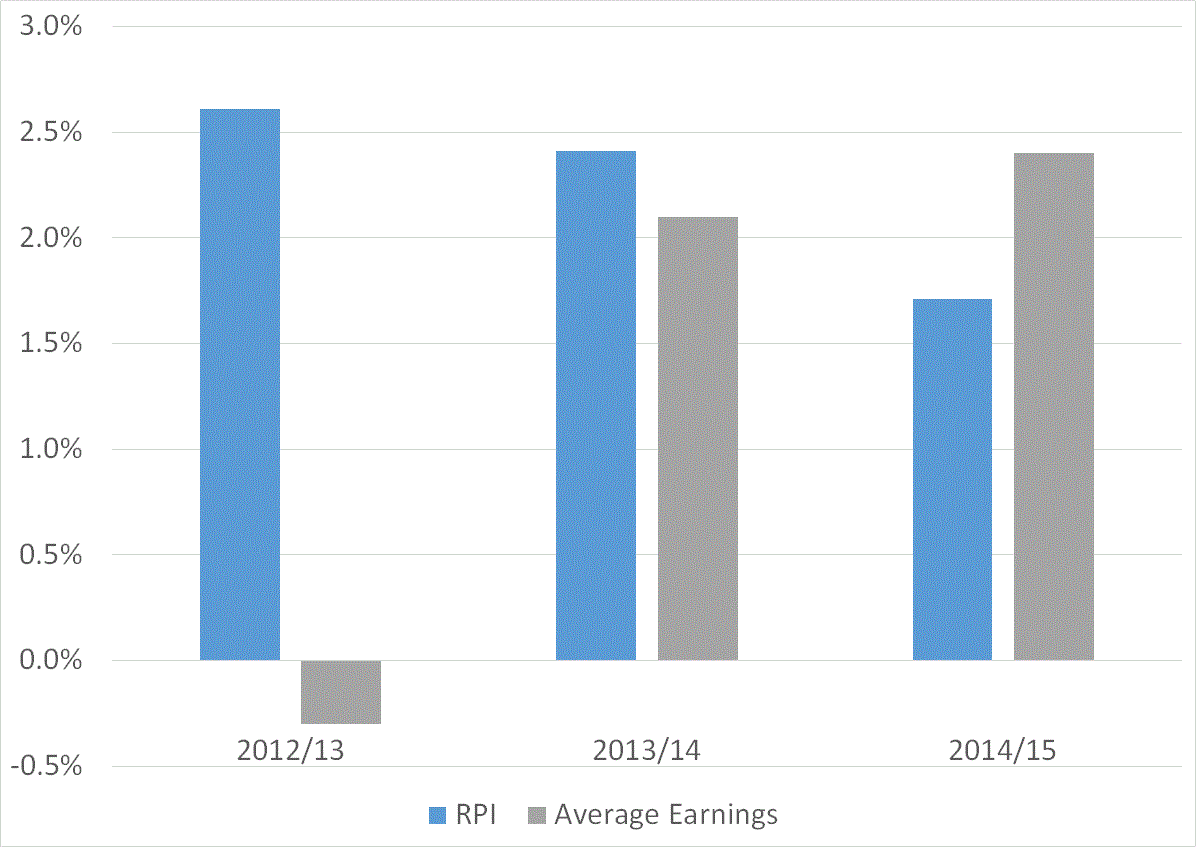
blog_graph_pensions

Since then each year pensions have got another 2.5%.  Boom – another cool two billion to spend on cruises and Werthers Originals. Average earnings have picked up but continue to grow at less than 2.5%.

The problem with this is that there are many, many more things that government could spend money on which would do more good for the country than shovelling cash into the pockets of old people.  For example, the UK Apprenticeships programme has been successfully providing young people with skills that employers explicitly want.  It has been evaluated as adding £18 to the economy for every pound of government money spend on it.  That is a return of 1800%.  Not bad Vince. Not bad.

You might be asking what is the return on spending on pensions.  Zilch.  A pound spent on pensions is merely moving money from one pocket to another.

In 2013/14 the total spend on all Enterprise and Skills programmes in the UK was £4bn.  The increase in spending on State Pension was half of the total spend on Enterprise and Skills.

If just a quarter of that increase were used for Apprenticeships that would mean the economy would not be only £250m better off, it would be £4.5bn better off.

Crappy spending decisions like the Triple Lock is why governments that listen disproportionately to old people are not good economic stewards.

Young people: Vote!

Older people, if you want your children and grandchildren to live in a wealthy society, don’t listen to the siren calls of bigger cash transfers. (and tell your children and grandchildren to vote).

Governments shouldn’t worry about red ink.

In this age of blogs, Twitter and newsfeeds the default position for most people is to ingest content that they find agreeable and which is presented in digestible chunks.  When 140 characters is the go-to format for most opinions, a 500 word piece for a blog or a newspaper is rarely on the menu.  Many of the arguments against the coalition government’s policy of fiscal consolidation have therefore attempted to conform to the preferred format of the content browsers who flit from one opinion tree to another.

This has meant that many opinions end up sounding shrill (Laurie Penny and Owen Jones, I’m looking at you) or failing to convey the subtlety that is important to so many economic issues.

An article by Oxford economist Simon Wren-Lewis in the latest issue of the London Review of books illustrates starkly why this is dangerous. (yes, it’s more than 500 words)

Public endorsement of the policy of fiscal consolidation (or austerity) has been fed by the presentation of the economy as being like a household or a business that has to balance its books to survive.  This simple analogy has been used by the Chancellor to demonstrate the Conservatives’ frugality and competence at economic management – everyone else has to try and stay in the black, so government should too.

This view has been mostly swallowed whole by the media and regurgitated to the public with little criticism. Media economic correspondents and commentators have tended to focus on the views of City economists who, as Wren-Lewis points out are generally either trying to be sensationalist or advance the interests of their investor clients.

The fact that the coalition government continues to poll well on economic management is based on the public having a completely wrong view of how a national economy actually works.  Regardless of whether you think the country would be better off with a smaller state, we should all be appropriately informed about the pros and cons are of the various ways of achieving it.

“Balancing the books” of government when the country is in a recession is a very bad idea. A very, very bad idea.

If a business or household is constantly spending more than it earns then its stock of debt will increase. For a business, increasing debt to make an investment can increase revenue, but using debt to finance your operations isn’t going to end well if there isn’t some external factor that is going to improve your margins.  Using debt to finance an investment is still risky as well because it may not pay you back – people might not buy the product, the oil well might be no good, the big machine may not be reliable.

When you’re running a national economy many of the constraints a business faces are absent.  For example, a government’s revenue comes from taxes.  Taxes increase with economic activity, either from income tax, corporate profits or consumption (via VAT).  Therefore, if a government can increase economic activity then they may be able to achieve a prolonged increase in tax revenue as people continue to spend money and add value with services and products.  Reducing current taxes is one way to do this – VAT was reduced in 2009 as a way to stimulated purchases.  Increasing spending is another way to stimulate economic activity.  Investment is a particularly good way to stimulate activity because an asset is created which generally delivers some improvement to the country’s infrastructure (better broadband connections, better roads etc, better school buildings) and also results in the people working on the infrastructure having more money in their pockets to spend on goods and services. The first effect is a bit risky; like the big machine, it may not work as intended.  However, if you pay a company to build a road then the workers and owners are definitely going to be better off.

The only thing that ever prevents this from being maximally effective is if people save the money they have.  In some countries this could be an issue: Japan and Germany.  However, one thing the UK population is particularly good at is spending money!

There are various ways to pay for these types of policies, but that is a separate issue.  The analogy of balancing the books with respect to budget deficits is completely bogus – the media should stop being so ignorant about the issue, academia should help them do this, and we the public should beware of politicians who present such simplistic arguments.

In 1925 Winston Churchill followed a similar policy to Osbourne’s in order to maintain the gold standard.  The British economy was crippled by debts to the USA after WW1 and Churchill’s attempts to ‘balance the books’ brought the country to its knees.  Things only really started improving with re-armament after 1935.  This was such an appalling misjudgement that John Maynard Keynes wrote a 32-page essay called The Economic Consequences of Mr. Churchill on why Churchill was an idiot.

If only Keynes were alive today (if only…), he would have written The Economic Consequences of Mr. Osbourne, and he would have been able to summarise it in 140 characters.